This report outlines Vehicle Energy Japan's approach to environmental, social, and governance (ESG) matters, as well as supply chain due diligence, along with our initiatives for fiscal year 2024.
Corporate governance forms a fundamental pillar of our company, and we have established a global management framework with coordinated efforts across all sites. To ensure its effectiveness, we also focus on awareness and educational initiatives for employees and business partners, promoting its principles throughout the organization.
Respect for human rights including the prohibition of child labor, forced labor, and discrimination, as well as the protection of employee health and safety is a fundamental principle of its management philosophy. Since our establishment in 2019, this commitment has been clearly stated in the Vehicle Energy Japan Standards of Conduct.
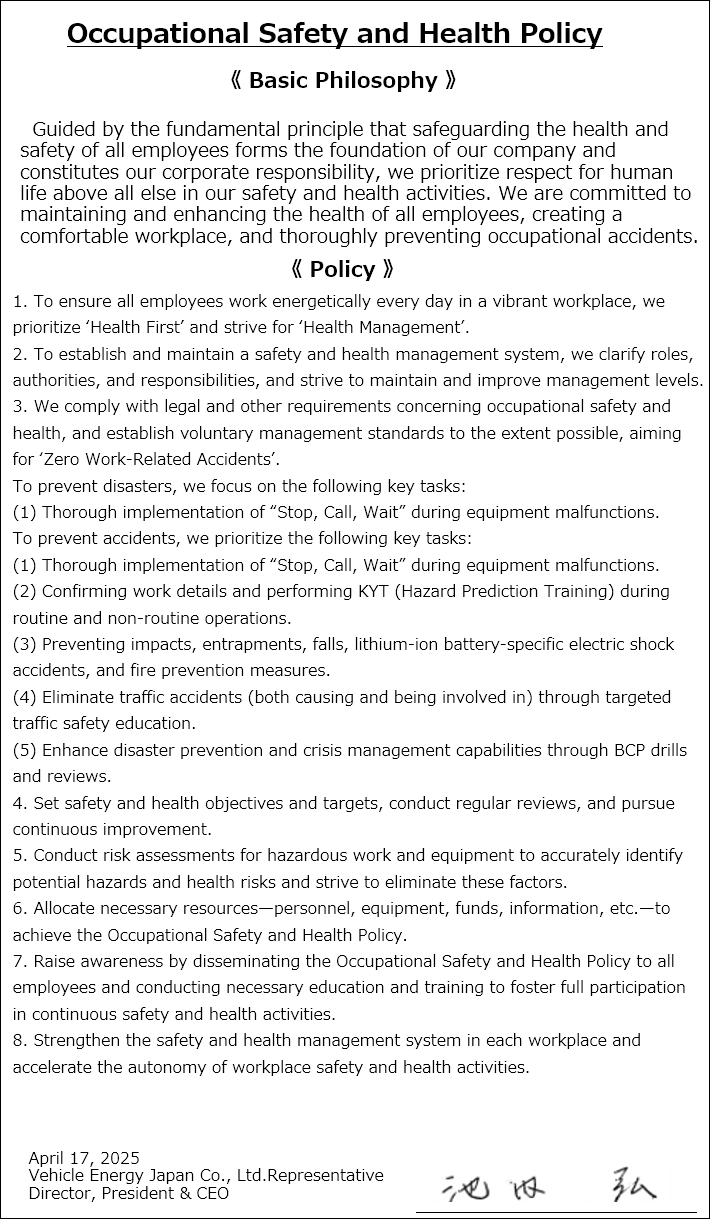
Our health and safety policies and principles, applied consistently across all countries, regions, and business units, affirm that labor safety and employee health are top priorities in all aspects of our operations. To foster a corporate culture where the safety and well-being of people are respected, we have established an Occupational Health and Safety Management System in accordance with the Ministry of Health, Labour and Welfare's Guidelines (Notification No. 113). This system is designed to reduce potential hazards, promote employee health, create a comfortable work environment, and continually enhance the overall safety and health standards at our workplaces.
Our company's President has formally declared its Occupational Safety and Health Policy, and the Company is implementing the following measures in accordance with this commitment.
In addition to providing attractive products and services to people around the world, we recognize that an important corporate responsibility is to actively engage with and contribute to local communities, leveraging our unique strengths as a member of society.
By providing various forms of information and resources to local communities, and actively participating in community revitalization and problem-solving efforts, we not only fulfill our responsibilities as corporate citizens but also benefit our business activities. Such engagement contributes to the creation of a better business environment and the development of sustainable and growing markets.
As one example, we regularly conduct blood donation drives and engage in cleanup activities around our facilities and along coastal areas.
As a global leader in lithium-ion battery technology, we are committed to designing, developing, manufacturing, and servicing automotive products that are precisely tailored to meet the evolving needs of our customers. Through continuous innovation and technological excellence, we contribute to the advancement of people, mobility, and society.
While pursuing technological advancement in harmony with the environment, we are committed to environmental conservation and responsible environmental management.
Our company is committed to contributing to the realization of a sustainable society in harmony with the environment. To this end, we have established an environmental management system based on ISO14001 and promote responsible business activities, products, and services.
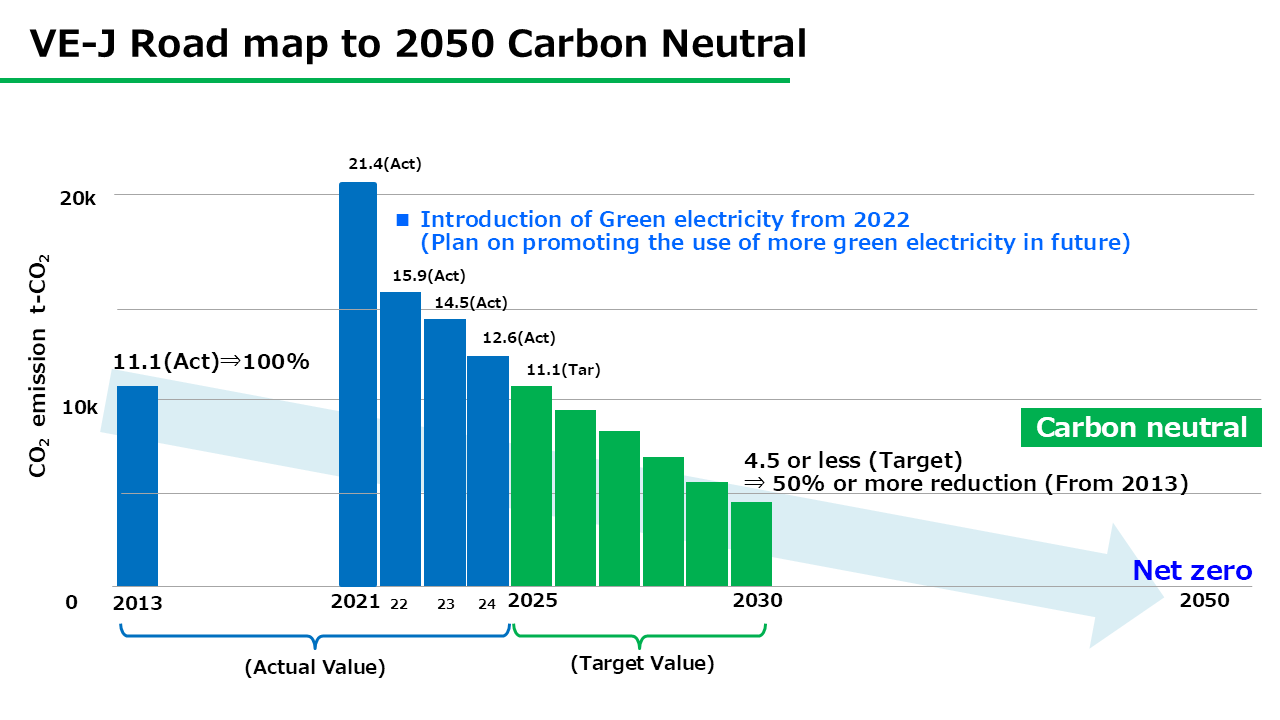
In response to the April 2023 revision of the Act on the Rational Use of Energy à the Act on Rationalizing Energy Use, which has been renamed the Act on Rationalization of Energy Use and Shift to Non-fossil Energy, our company has established and implemented the 'Standard for the Rational Use of Energy and Conversion to Non-Fossil Energy.' Through this framework, we aim to promote energy conservation, advance the transition from fossil fuels to renewable energy, and contribute to achieving carbon neutrality.
In alignment with Japan's national goal of achieving carbon neutrality by 2050 and driving societal transformation, we are actively engaged in the challenge of Green Transformation (GX). As participants in the GX League — a public-private-academic initiative aimed at realizing sustainable growth in both current and future societies — we are working to reduce CO2 emissions based on our own strategic plan.
In addition to our CO2 reduction efforts, we have established a procedure titled “Management Protocol for Specified Products Related to Fluorocarbons,” through which we are actively engaged in managing and reducing other atmospheric pollutants.
Based on “the Act on Rationalization of Energy Use and Shift to Non-fossil Energy” we are actively engaged in energy-saving initiatives aimed at reducing CO2 emissions.
Globally, population growth and economic development are expected to drive increasing demand for water. At the same time, climate change is altering rainfall patterns, heightening societal concern over the stability and reliability of water supply.
By 2030, global freshwater supply is projected to fall short of demand by 40%, highlighting the urgency of addressing water-related challenges. In the World Economic Forum's annual Global Risks Report, risks associated with water — such as extreme weather events, natural resource crises, and environmental damage — consistently rank among the most critical threats to global stability.
In accordance with our environmental policy outlined in the Environmental Manual — “Promoting nature conservation and ecosystem preservation through business activities for harmonious coexistence with nature” — we implement water resource management, simplified water supply systems, and wastewater control through the following procedures.
It has long been recognized that waste has a significant impact on the natural environment, particularly on wildlife, across the globe. In response, we have incorporated the following principles into our environmental policy, as outlined in the Environmental Manual, and are actively implementing them.
We promote environmentally responsible manufacturing practices across all stages — from product research and development, design, procurement of materials, production, distribution and sales, to usage and disposal — with the aim of reducing environmental impact.
In accordance with the regulations and standards set forth in the “Act on Waste Management and Public Cleansing”, we have developed and implemented a “Waste Management Procedure” to ensure proper handling and disposal of waste generated within the company. This procedure clarifies the responsibilities and operational steps necessary to promote autonomous waste management, resource recycling, and waste reduction.
Furthermore, we follow the procedure outlined below when entering into basic contracts with contractors for the collection, transportation, and disposal of industrial waste.
Meanwhile, within our company, we define the required competencies for personnel engaged in activities that affect environmental performance or are necessary to meet compliance obligations identified through environmental impact assessments. We clarify training needs, ensure that individuals possess the required competencies, and verify the effectiveness of these measures. Furthermore, we promote awareness among all employees regarding the environmental impacts of their work.
We do not use any hazardous substances regulated under the Act on Control of Household Products Containing Harmful Substances. Furthermore, all chemical substances handled in accordance with the Chemical Substances Control Law are centrally managed, and we regularly verify that they are stored and used appropriately.
In addition, we have certified instructors for organic solvent operations, as well as licensed supervisors for the handling of poisonous and hazardous substances. These qualifications enable us to provide training on the safe use of organic solvents and related hazardous materials.
We comply with both the legal regulatory limits and voluntary management standards for noise and vibration at the site boundary. To contribute to the protection of the local environment, we have established and operate in accordance with the “Noise and Vibration Management Procedure Manual.”
Furthermore, the following matters are stipulated and implemented.
In line with the environmental policy set forth in our Environmental Manual — 'to promote nature conservation and ecosystem preservation through our business activities in harmony with nature' — our company implements soil protection initiatives.
Based on the environmental policy stated in our Environmental Manual — "to promote nature conservation and ecosystem preservation through business activities for harmonious coexistence with nature" — we implement initiatives for the protection of biodiversity and ecosystems.
Furthermore, we support and engage in activities related to the global target adopted in the 'Kunming-Montreal Global Biodiversity Framework' in December 2022, which aims to effectively conserve more than 30% of terrestrial and marine areas as healthy ecosystems by 2030 ('30 by 30').
As part of our plant safety measures, we are enhancing our preparedness for emergency situations. To ensure readiness and effective response to potential emergencies, we have established, implemented, and maintained the following processes.
In the event of damage to production facilities caused by natural disasters such as earthquakes or heavy rainfall, we will formulate and implement recovery procedures and planning flowcharts to ensure the prompt restoration of production activities.
Vehicle Energy Japan believes that advancing business activities with a focus on sustainability across the entire value chain contributes to the mutual prosperity of our procurement partners. To achieve this, we actively work to identify and mitigate potential risks in the supply chain associated with the globalization of business — such as human rights violations and adverse environmental impacts — and promote sustainable procurement practices.
In procurement activities, we have established our Basic Procurement Policy and the Code of Conduct that procurement partners are expected to comply with, as the "Supplier CSR Procurement Guidelines.
This guideline outlines the requirements that procurement partners are expected to comply with, covering seven major categories: "Labor", "Health and Safety" ,"Environment", "Business Ethics", "Management Systems" ,"Quality and Safety" , and "Prevention of Leakage of Personal and Confidential Information." It also serves as a communication tool to convey our company's initiatives to our procurement partners.
By promoting procurement activities in accordance with these guidelines, we aim to fulfill our social responsibilities through corporate activities together with our procurement partners, and contribute to the realization of a sustainable society.
* Please refer to the Supplier CSR Procurement Guidelines available on our company website.
https://www.ve-j.co.jp/en/company-06.html
This policy sets forth the code of conduct to be observed by all officers and employees of the Company in the procurement of materials, products, services, and information essential to our business operations from external sources.
We respect fair and equitable business relationships with all procurement partners and conduct our procurement activities based on the principles of free competition and equal opportunity, regardless of whether they are domestic or international.
We strive to build strong partnerships with our procurement partners, working from a long-term perspective to enhance mutual understanding and trust. Through these efforts, we are committed to creating value and functionality that meet the expectations of our customers and society.
We promote CSR procurement activities in collaboration with our procurement partners by fulfilling our social responsibilities. These include fair and transparent information disclosure, compliance with laws and social norms, respect for human rights, elimination of discrimination in employment and occupation, eradication of child and forced labor, environmental conservation efforts, social contribution initiatives, creation of a comfortable and inclusive workplace, and the sharing of social responsibility awareness with our business partners.
The policy explicitly prohibits the receipt of personal benefits from procurement partners. Our internal regulations establish strict rules regarding entertainment and gifts, generally prohibiting them, thereby preventing bribery and corruption and ensuring full compliance in procurement activities.
We have established the following provisions as the "Code of Conduct for Procurement Partners" within our Supplier CSR Procurement Guidelines. We expect our procurement partners not only to comply with applicable laws and regulations, but also to fulfill their social responsibilities through corporate activities as members of society. In other words, they are expected to actively engage in Corporate Social Responsibility (CSR) and to demonstrate responsible corporate behavior.
Prohibition of Forced and Child Labor, Compliance with Working Hours, Fair Wages and Benefits, Humane Treatment of Workers, Elimination of Discrimination and Harassment, and Freedom of Association.
Ensuring occupational safety, preparing for emergencies, responding to work-related injuries and illnesses, promoting industrial hygiene, considering the impact of physically demanding tasks, implementing safety measures for machinery and equipment, providing sanitary facilities, meals, and housing, and communicating matters related to health and safety.
Obtaining and maintaining necessary permits and reporting, pollution prevention and resource reduction, management of environmentally hazardous substances, management, reduction, and disposal of solid waste, air emissions control, restriction of substances used, water resource management, energy consumption and greenhouse gas emission management and reduction, and conservation of biodiversity and ecosystems.
Prohibition of bribery, corruption, extortion, and embezzlement; elimination of improper benefits; disclosure of information; protection of intellectual property rights; compliance with fair business, advertising, and competition laws; protection of whistleblowers and elimination of retaliation; and promotion of appropriate export and import controls.
Establishing a framework for continuous improvement in relation to policy compliance, implementation systems, risk identification and assessment, corrective actions, and stakeholder engagement.
Ensuring Product Safety and Promoting Quality Assurance Activities
Defense against network-based threats including cyberattacks, formulation of privacy protection measures, prevention of personal information leakage, and formulation of measures to prevent leakage of confidential information of customers and third parties.
We are committed to responsible procurement practices to avoid sourcing components and materials that contain conflict minerals potentially associated with human rights violations — support for armed groups, human rights violations such as child labor, acts of corruption, and environmental destruction — in conflict-affected and high-risk areas. Relevant regulations include the U.S. Dodd-Frank Wall Street Reform and Consumer Protection Act, which covers tin, tantalum, tungsten, and gold, as well as the European Battery Regulation, which applies to lithium, cobalt, nickel, and natural graphite.
Specifically, we strive to develop a clear understanding of the social issues present in mineral-producing countries, as well as the roles expected of businesses operating in such regions. In addition, we identify and evaluate risks using internationally recognized indicators, such as the EU CAHRAs and global governance metrics. Through these efforts, we actively promote due diligence to support the establishment of responsible supply chains for minerals sourced from conflict-affected and high-risk areas.
We request our procurement partners to conduct supply chain investigations using internationally recognized tools, such as the Conflict Minerals Reporting Template (CMRT) provided by the Responsible Minerals Initiative (RMI). These investigations should include identifying the countries of origin of minerals and the smelters involved. Based on the results of these investigations, we carry out risk assessments. If any risks are identified, we request further investigation and encourage sourcing exclusively from smelters that are compliant with the Responsible Minerals Assurance Process (RMAP).
To strengthen our efforts in Corporate Social Responsibility (CSR), including supply chain due diligence, we will distribute a CSR Self-Assessment Questionnaire (SAQ) to our procurement partners. This questionnaire comprehensively covers the requirements outlined in our CSR guidelines, and we request our partners to conduct a self-assessment accordingly.
We will provide feedback on the results of this self-assessment to our procurement partners. In cases where issues are identified that are deemed to have a negative impact on human rights or the environment, we will actively engage with the relevant parties to encourage corrective actions.





|
|
|
|
|